
Riverside is one of Southern California's most rewarding places to buy — more space, more character, and more breathing room than the coastal markets many buyers start out considering. But getting the local details right before you tour a single home makes all the difference between a confident offer and an expensive lesson.
What buyers usually want to know first
Most buyers coming to Riverside for the first time have the same handful of questions: What are homes actually selling for right now? How does the buying process work in California? And will I be competing against a dozen other offers on everything I like?
The short answer on pricing: as of early 2026, the median sale price in Riverside sits at approximately $633,000, down slightly from a year ago, with homes averaging around 49 days on market. That's a meaningfully different environment from the frenzied pace buyers faced in 2021 and 2022. Inventory has grown, days on market have stretched, and sellers in most price ranges are negotiating in good faith. For buyers who've been waiting on the sidelines, this is a noticeably more balanced market.
On the financing side, budget for closing costs in California that typically fall between 2% and 5% of the purchase price. On a $633,000 home, that means setting aside roughly $12,600 to $31,650 above and beyond your down payment. The specific split between buyer and seller is negotiable, and in Southern California custom, sellers typically cover the owner's title insurance while escrow fees are split — so buyers are primarily responsible for lender-related charges, prepaid interest, and homeowners insurance.
Pre-approval is non-negotiable before you tour homes seriously. Sellers across Riverside expect a strong pre-approval letter in any offer package, and working with a local or regionally experienced lender gives you an edge when timelines matter.
| Key Buying Cost | Typical Range (Riverside) |
|---|---|
| Down payment (conventional, 10–20%) | $63,300 – $126,600 |
| Closing costs (buyer's share) | $12,600 – $31,650 |
| Home inspection | $350 – $600 |
| Homeowners insurance (annual, est.) | $1,500 – $2,600+ |
| Property taxes (annual, ~1.1–1.25%) | $6,963 – $7,913 |
First-time buyers should also be aware that California CalHFA programs offer down payment assistance and closing cost support for income-qualified applicants — worth exploring before you assume the full cash requirement falls entirely on you.
For buyers relocating from Orange County or Los Angeles, the payment math in Riverside still pencils out more favorably than what coastal markets offer at comparable home sizes. That comparison continues to draw buyers across the county line, though the gap has narrowed from its pandemic-era peak. Super Woman Super Realtors works with buyers at exactly this decision point — helping them understand what their budget actually buys in Riverside versus the alternatives. You can explore what it really costs to live here before committing to a search.
How Riverside neighborhoods differ
Riverside doesn't have one personality — it has several, and they're genuinely distinct. Choosing the wrong neighborhood for your lifestyle and commute pattern is one of the most common mistakes buyers make when they focus exclusively on price per square foot.
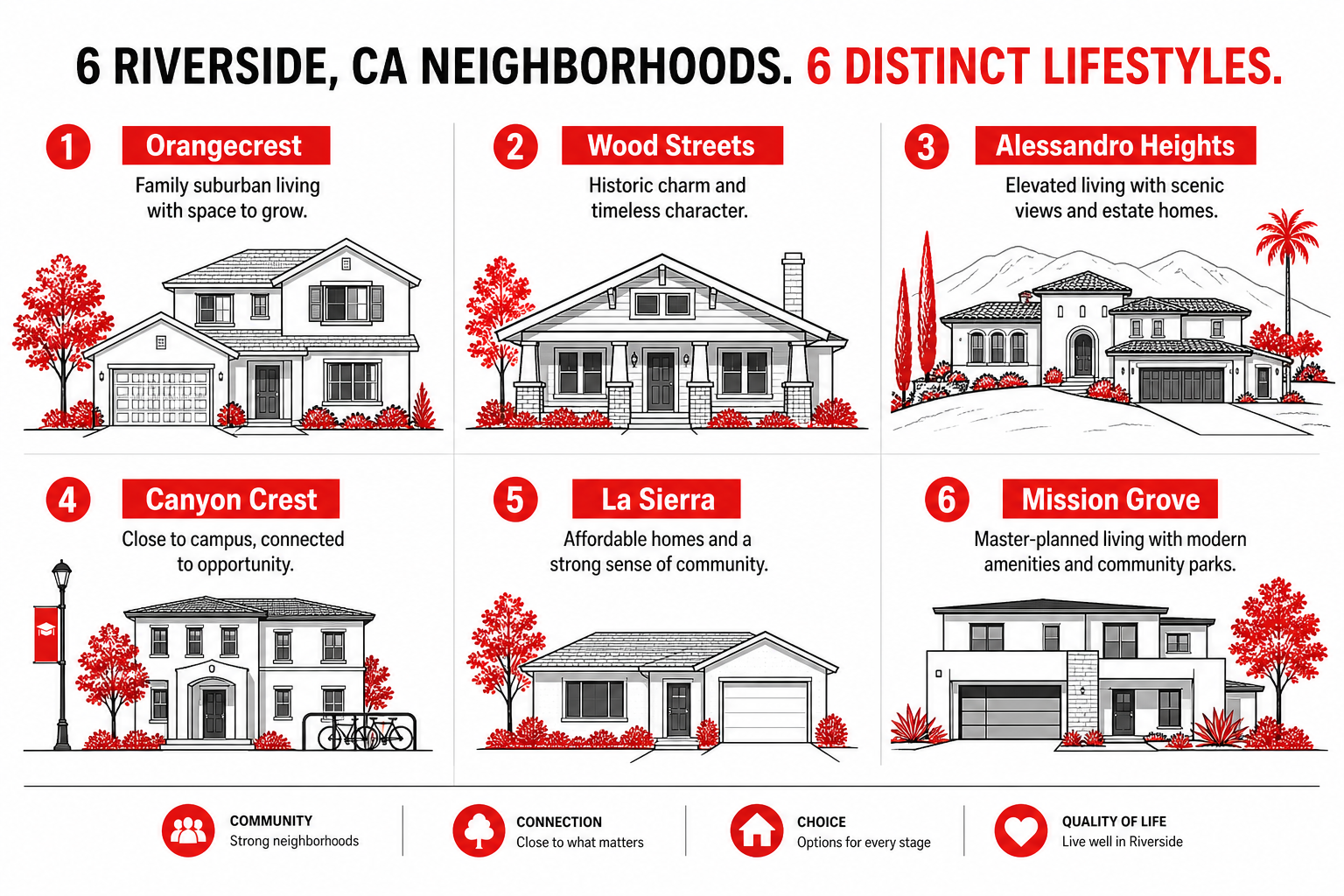
Here's a practical look at the neighborhoods that come up most often in buyer conversations:
Orangecrest is the go-to for families with school-age children. It's a master-planned community in the southeastern part of the city, known for newer single-family homes, larger lots, low crime rates, and easy access to the 91 Freeway for commuters heading toward Corona and Orange County. Prices typically range from the mid-$500s to the mid-$700s depending on size and condition.
Canyon Crest runs along the eastern edge of the city, adjacent to UC Riverside, and offers a broader mix of home styles — mid-century builds, later subdivision homes, condos, and some estate properties on canyon-facing lots. It appeals to professionals, academics, and buyers who want character and proximity to outdoor recreation without paying Alessandro Heights prices. Canyon Crest Town Center keeps daily errands convenient.
Wood Streets is Riverside's most architecturally distinctive neighborhood — Craftsman bungalows, Spanish colonials, and early 20th-century homes on tree-lined streets within walking distance of Downtown. Buyers here are usually looking for historic charm, original details, and a walkable, community-oriented lifestyle. Median prices hover near $620,000, with some fully renovated homes pushing above $1 million.
La Sierra, positioned along the 91 Freeway corridor in western Riverside, is the most accessible entry point for first-time buyers and investors. Housing stock is diverse — 1950s ranch homes, newer townhomes, and small-lot developments — and prices remain below the city median in many pockets. La Sierra University anchors the neighborhood's sense of community.
Alessandro Heights at the upper end of the market offers hillside estates, larger custom lots, and elevated views. It's private, scenic, and carries a prestige address — but buyers should know that walkability is minimal and the price premium is real.
Mission Grove, a newer master-planned area in southern Riverside, is popular with buyers who want modern construction and move-in-ready homes without the premium of Orangecrest. Prices generally fall between the low $500s and low $700s.
The full Riverside neighborhood guide breaks down each area in more depth, including school ratings, commute context, and lifestyle fit by buyer profile. For anyone weighing Riverside against West Los Angeles or the broader Inland Empire, house hunting tips specific to the Inland Empire are worth reading before your first weekend of tours.
| Neighborhood | Best For | Approx. Price Range | Character |
|---|---|---|---|
| Orangecrest | Families, 91 Fwy commuters | Mid $500s – Mid $700s | Master-planned, suburban, newer |
| Canyon Crest | Professionals, UCR proximity | Mid $400s – $900s+ | Mixed era, scenic, community-oriented |
| Wood Streets | Historic charm buyers | $550K – $1M+ | Craftsman, walkable, downtown-adjacent |
| La Sierra | First-time buyers, investors | Low $400s – Mid $500s | Diverse stock, value-focused |
| Alessandro Heights | Move-up, estate buyers | $800K – $2M+ | Hillside, private, custom homes |
| Mission Grove | Modern construction seekers | Low $500s – Low $700s | Master-planned, move-in ready |
One thing that surprises buyers who come from more homogeneous markets: Riverside genuinely rewards taking time to visit each neighborhood at different times of day. Traffic on the 91 and 215 freeways behaves differently depending on which side of the city you're on, and commute times can vary by 20 minutes or more depending on the specific address.
What to check before you tour homes
This is where buying a home in Riverside CA gets local in ways that matter. There are several factors specific to this market — and to California more broadly — that deserve attention before you walk through a single front door.
Wildfire zone and insurance availability. According to Redfin data, approximately 53% of Riverside properties carry some wildfire risk over the next 30 years. The City of Riverside adopted updated Fire Hazard Severity Zone maps, and the Riverside Fire Department now runs an annual Defensible Space Inspection Program for homes in high and very high hazard zones. For buyers, this means two things: first, ask your agent to pull the specific fire zone designation of any property you're considering, and second, get homeowners insurance quotes early — before you're under contract, not after. Riverside homeowners insurance premiums can run 20–30% above California averages for comparable coverage, and in the hillside areas, admitted carriers have pulled back significantly. The California FAIR Plan exists as a last resort, but layering it with a Difference in Conditions policy adds cost and complexity. Get at least three quotes and factor the annual premium into your monthly payment math before you fall in love with a house.
HOA documents and financial health. Many Riverside communities — particularly in Orangecrest, Mission Grove, and Canyon Crest — are governed by homeowners associations. California law gives buyers the right to review HOA documents after an offer is accepted, but smart buyers ask for the CC&Rs, budget, reserve study, and recent meeting minutes before removing contingencies. An underfunded reserve account is a red flag; it typically means a special assessment is coming, and you don't want to inherit that surprise six months after closing.
Property condition and inspection scope. A standard general inspection covers structure, roof, plumbing, electrical, and HVAC — but Riverside's climate and age of housing stock mean a few additional inspections are worth considering. Older homes in Wood Streets and Victoria may have galvanized plumbing or knob-and-tube wiring that a general inspector flags but doesn't fully evaluate. For hillside properties in Canyon Crest or Alessandro Heights, a geological or soils report can reveal drainage issues or slope stability concerns that aren't visible on a tour. Sewer lateral inspections are increasingly standard in the Inland Empire market and can prevent a $10,000–$40,000 surprise after close.
Commute and infrastructure reality. The 91 and 215 freeways are Riverside's main arteries, and they have well-known congestion patterns. If you're commuting to Orange County or Los Angeles, run the actual drive — not Google Maps in off-peak hours — on a Tuesday morning before you commit to a neighborhood. Metrolink's Inland Empire–Orange County line and the 91/Perris Valley Line offer alternatives for some commuters, but service frequency is limited compared to urban rail systems.
Mello-Roos and special assessments. Newer neighborhoods in Riverside — particularly master-planned communities built after the early 1990s — often carry Mello-Roos Community Facilities District charges. These appear on the property tax bill and can add $1,000–$3,000 or more per year on top of the base property tax rate. Always ask your agent to pull the full tax bill breakdown, not just the base rate, on any newer-construction property.
Being thorough here isn't about being cautious for caution's sake. It's about making sure the home you're excited about today remains a strong financial decision five years from now. The team at Super Woman Super Realtors has helped buyers navigate exactly these layers across Riverside, the Inland Empire, and broader Southern California — providing the kind of hands-on guidance that makes the difference between a transaction and a genuinely good outcome.
If you're still in the early stages of deciding whether Riverside is the right fit, the complete 2026 guide to living in Riverside walks through schools, lifestyle, and neighborhood character in depth. And if you're considering the broader Southern California market, it's worth understanding what it looks like to buy in Los Angeles before deciding where your search begins.

Frequently Asked Questions
What is the median home price in Riverside, CA right now?
As of early 2026, the median sale price in Riverside is approximately $633,000, with homes spending around 49 days on market before going under contract.
Which Riverside neighborhood is best for families?
Orangecrest is the most consistently recommended neighborhood for families, offering newer homes, strong schools, low crime rates, and easy 91 Freeway access.
How much should I budget for closing costs when buying in Riverside?
Budget 2% to 5% of the purchase price. On a $633,000 home, that's roughly $12,600 to $31,650 above your down payment, covering lender fees, escrow, and prepaid expenses.
Do I need to worry about wildfire risk when buying in Riverside?
Yes. Around 53% of Riverside properties carry some wildfire risk. Check the fire zone designation of any home you consider and get insurance quotes before going under contract.
What is Mello-Roos and does it apply in Riverside?
Mello-Roos is a special tax on newer California communities that funds local infrastructure. It adds to the annual property tax bill and is common in Riverside's master-planned neighborhoods.