
Riverside sits roughly 60 miles east of Los Angeles and offers buyers something genuinely rare in Southern California: a median home price well below the coastal average, real square footage, and a community that has been growing steadily for years. But moving to Riverside California is not a one-size decision. The commute can be brutal during peak hours, some neighborhoods fit certain lifestyles far better than others, and the summer heat is not a minor detail. This guide lays out the honest tradeoffs so you can put Riverside in its proper place on your shortlist.
What Makes Riverside Appealing to Some Buyers
The most immediate draw is purchasing power. According to Redfin data through April 2026, the median sale price in Riverside was approximately $630,000 over the three months ending April 2026. Compare that to the statewide median of around $823,000 in early 2026, and the gap becomes significant for buyers who need every dollar to work harder.
Buyers relocating from Los Angeles or Orange County consistently find they can get substantially more space for the same monthly payment. A three-bedroom, two-bath home with a backyard and a two-car garage that might price at $1.1 million in parts of West LA can often be found well under $700,000 in Riverside neighborhoods like Orangecrest or Canyon Crest. For families weighing school quality, yard space, and long-term stability, that math is hard to ignore. You can explore a deeper look at Inland Empire real estate trends and buyer opportunities through Super Woman Super Realtors.
Home Prices Versus the Rest of Southern California
Riverside's relative affordability within Southern California has been consistent even as the market softened slightly heading into 2026. The table below puts the price gap in context:
| Market | Approx. Median Home Price (Early 2026) | Avg. Days on Market |
|---|---|---|
| Riverside, CA | ~$630,000–$665,000 | 42–72 days |
| Los Angeles (Metro) | ~$900,000+ | 45–60 days |
| California Statewide | ~$823,000 | Varies |
| Orange County | ~$1,100,000+ | 30–45 days |
Sources: Redfin, Houzeo, and local market aggregators, April–May 2026.
The Riverside market is described by most analysts as balanced to slightly buyer-favorable heading into mid-2026, with roughly 45% of homes seeing some form of price reduction before sale. That is meaningfully different from the frenzied conditions of 2021 and 2022, and it creates genuine negotiating room for prepared buyers.
Neighborhood Character and Quality of Life
Riverside is not a single-flavor city. It has distinct neighborhoods with very different personalities, price points, and school ratings. Families oriented around top public schools tend to gravitate toward Orangecrest, which carries an A school rating and a median home value near $698,000 according to NewHomeSource neighborhood data. Canyon Crest appeals to buyers who want scenic hillside settings, proximity to UC Riverside, and a walkable commercial village. Wood Streets draws buyers who specifically want 1920s Craftsman character, walkability to downtown, and a tight-knit block feel.
For a full breakdown of neighborhoods by lifestyle, schools, and price, the Riverside neighborhood guide for families, foodies, and first-time buyers from Vicki Galvan covers this in practical detail.
Lifestyle Assets That Carry Real Weight
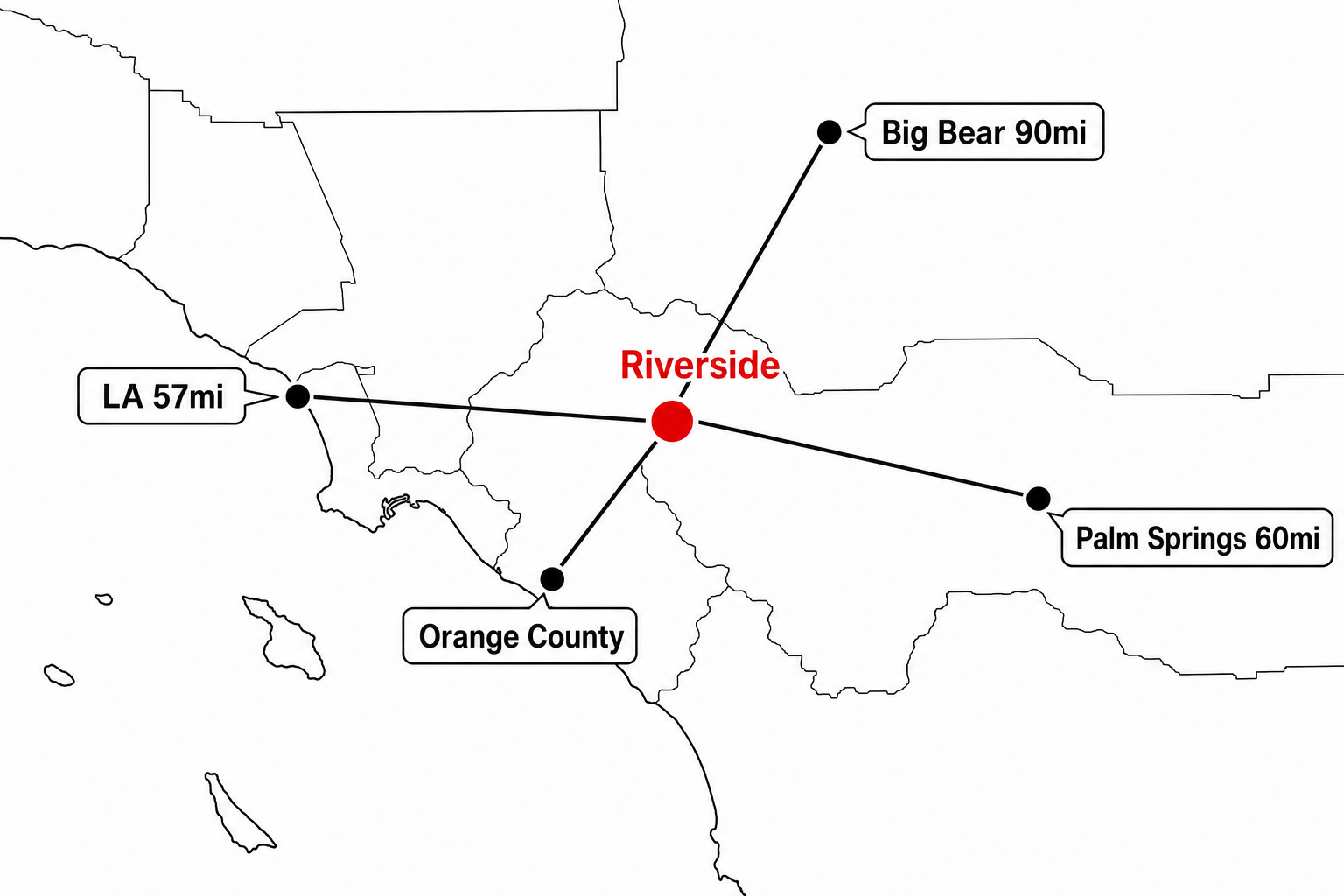
Beyond price, Riverside has geographic advantages that buyers do not always anticipate. Big Bear Lake is roughly 90 minutes away. Palm Springs is less than an hour east. The coast via Newport Beach or Huntington Beach is around 70 to 90 minutes depending on traffic. For buyers who want mountains, desert, and ocean all within a long weekend's reach, Riverside's position in the Inland Empire is genuinely valuable.
The city's cultural anchor, the Mission Inn Hotel and Spa, sits in a downtown that has been gaining new restaurants and public spaces steadily. UC Riverside brings a college-town energy to the University neighborhood. The California Citrus State Historic Park and established parks across neighborhoods like Orangecrest and Victoria give families outdoor options without leaving the city.
What Buyers Should Think Through Before Moving
Honesty matters here. Riverside has real tradeoffs, and buyers who skip this part of the evaluation tend to feel surprised after closing.
The Commute Reality
If you are buying in Riverside specifically because it is cheaper than LA but plan to commute to the Westside or downtown LA five days a week, plan your schedule with clear eyes. The drive from Riverside to central Los Angeles covers roughly 54 to 57 miles and takes about 58 minutes under ideal conditions. During morning peak hours, that number climbs to 90 minutes or more each way. That is a daily commitment of three or more hours in the car on a bad day.
Metrolink's Inland Empire-Orange County and Riverside lines offer a rail alternative to LA Union Station, with the ride running about 90 minutes. For buyers with some schedule flexibility or remote-hybrid arrangements, the train is a legitimate option that removes the stress of freeway driving entirely. The Inland Empire to LA commute breakdown covers this tradeoff in depth, including honest data on whether the square footage trade is worth it for different household types.
Buyers who work locally in Riverside, in healthcare at Riverside University Health System, in education at UCR, or in the logistics and distribution sector that anchors the Inland Empire economy, will find the commute issue almost irrelevant. The question is really only difficult for buyers with coastal or downtown LA jobs.
Summer Heat and Climate Considerations
Riverside is inland. Summers are hot, and the heat is measurably more intense than coastal cities. Redfin climate risk data projects that Riverside could see a significant increase in extreme heat days over the next 30 years. In practical terms for buyers right now, this means air conditioning is not optional, utility costs run higher in summer months, and buyers with young children or health sensitivities should factor this into lifestyle planning.
Fire risk is also worth understanding. According to Redfin climate data, approximately 53% of Riverside properties carry some wildfire risk over a 30-year horizon. Buyers should request a full natural hazard disclosure and discuss home insurance implications before making an offer in hillside neighborhoods like Canyon Crest or Alessandro Heights. You can also review the complete 2026 guide to living in Riverside CA for a deeper look at what daily life actually involves.
Neighborhood Fit Is Not Uniform
Not all of Riverside is the same, and this point deserves repetition. Neighborhoods like Orangecrest and Canyon Crest consistently rate A or B+ on school quality and safety metrics. Other parts of the city have higher crime rates and lower school ratings. Buyers who choose a neighborhood based purely on price without checking school data through California's School Dashboard or researching neighborhood-level crime trends can find themselves in a location that does not match what they expected.
Buyers with school-age children should spend time specifically comparing the Riverside Unified School District's ratings by attendance area, not just the district-wide average. The cost of living in Riverside for 2026 also breaks down what typical household expenses look like once you factor in utilities, transportation, and services rather than just the mortgage.
The Question of Long-Term Value
Riverside's price appreciation has been real but uneven. From a peak in 2022, prices corrected modestly and have settled into a more stable range. Most local projections point to 2% to 4% annual appreciation through the remainder of 2026, which is modest but positive compared to some coastal markets that have seen sharper corrections. The market is not a get-rich-quick play, but it is a stable, utility-driven housing market with genuine demand from buyers priced out of LA and Orange County.
For buyers who want to understand what their existing home is worth before making a move, the home value estimator tool can provide a quick starting point.
How to Decide Whether It Belongs on Your Shortlist
Riverside makes the most sense for a specific type of buyer. It rewards people who have honest clarity about their own priorities. Here is a straightforward way to frame the decision:
Riverside is likely a strong fit if:
- Your household income qualifies you for a $500,000 to $750,000 purchase but coastal markets put that budget well into condo territory
- You work locally in Riverside or the Inland Empire, or have a remote or hybrid schedule that limits commute days
- School quality and outdoor space for children rank above proximity to West LA nightlife or the beach
- You are buying for long-term stability rather than short-term appreciation
Riverside may not be the right fit if:
- You have a five-day-a-week commute to the Westside or downtown LA and are not prepared for 90-minute drives
- You have strong heat sensitivity or health conditions that make Inland Empire summers genuinely difficult
- Walkability and urban density are core to your lifestyle, since Riverside is predominantly car-dependent
- You want the brand equity of a coastal zip code for personal or professional reasons
The comparison most buyers are actually making is between Riverside and somewhere in West Los Angeles or the San Gabriel Valley. For that comparison, the West Los Angeles neighborhood guide provides useful context on what the coastal alternative actually looks and costs like in 2026.
A Practical Shortlist Checklist
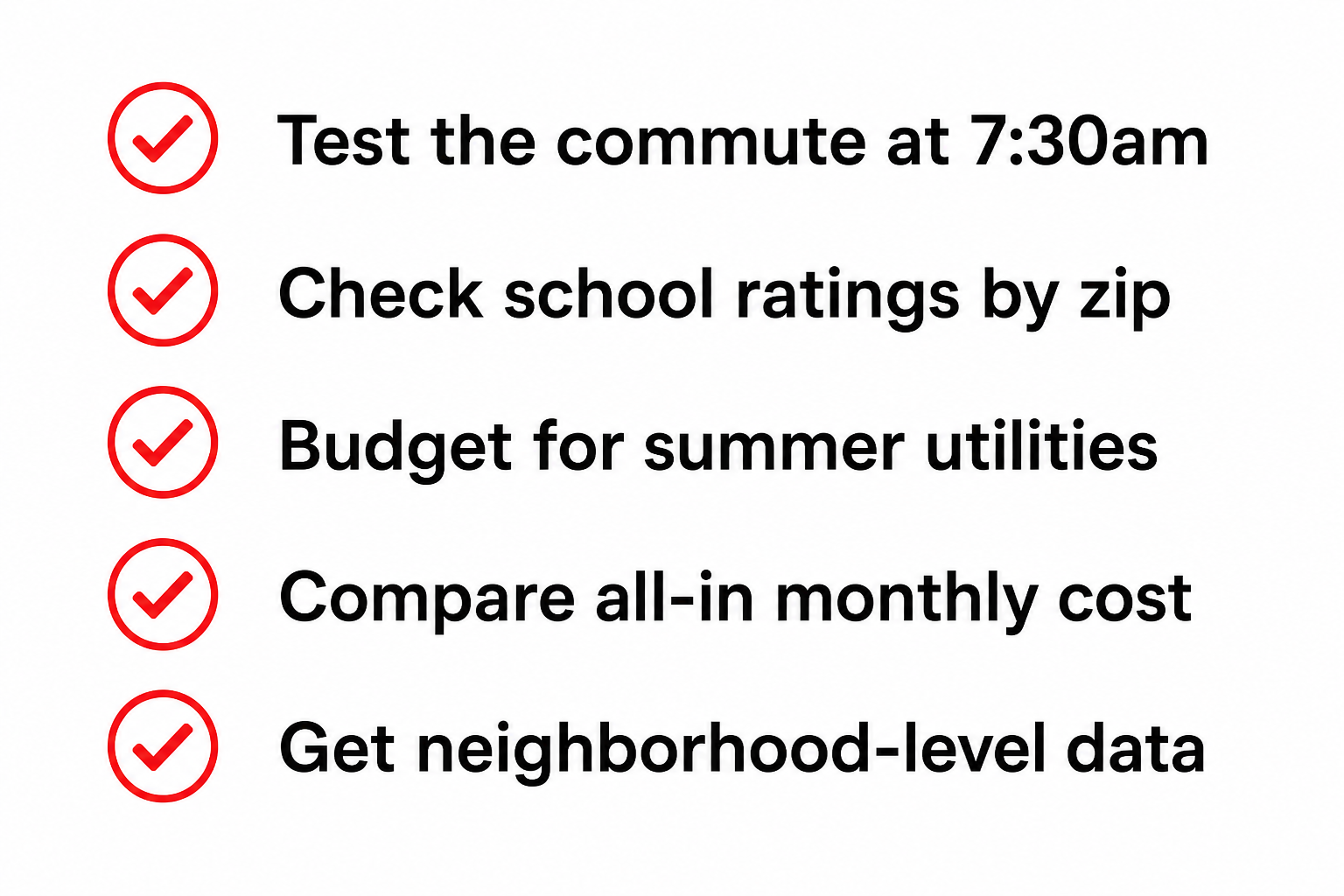
Before putting in an offer in Riverside, run through these questions:
- Have you driven the commute route at 7:30 AM on a weekday, not just checked Google Maps?
- Have you identified two or three specific neighborhoods, not just the city generally, and checked their school ratings and crime data?
- Have you accounted for summer utility bills and home insurance in a wildfire-risk area in your monthly budget?
- Have you compared the all-in monthly cost (mortgage, taxes, insurance, HOA if applicable) against your best coastal alternative?
- Have you spoken with a local agent who can show you micro-market data by zip code rather than county-level averages?
That last point matters more than most buyers expect. Riverside's micro-markets perform very differently depending on the specific neighborhood and street. County-level or even city-level data masks those differences. Working with someone who knows the Inland Empire real estate market at a neighborhood level gives you a real edge.
Neighborhood Quick Reference for Buyers
| Neighborhood | Best For | Median Home Value | School Rating |
|---|---|---|---|
| Orangecrest | Families, top schools | ~$698K | A |
| Canyon Crest | Outdoor rec, UCR proximity | ~$665K | A- |
| Mission Grove | Convenience, modern living | ~$665K | A- |
| Wood Streets | Character homes, walkability | Lower | B+ |
| Alessandro Heights | Luxury, privacy, views | ~$765K+ | A- |
| La Sierra | First-time buyers, affordability | Lower | B |
Source: NewHomeSource neighborhood data, 2026.

Frequently Asked Questions
Is Riverside California a good place to buy a home in 2026?
For buyers who prioritize affordability and space over coastal proximity, yes. The market is balanced and prices remain significantly below the California statewide median.
How far is Riverside from Los Angeles?
Roughly 54 to 57 miles by road. Expect 60 minutes off-peak and 90 or more minutes during morning rush hour in each direction.
What are the best neighborhoods in Riverside for families?
Orangecrest, Canyon Crest, and Mission Grove consistently rank highest for school quality, safety, and family amenities in 2025 and 2026 data.
Does Riverside have a wildfire risk?
Yes. Approximately 53% of Riverside properties carry some wildfire risk over a 30-year period according to Redfin climate data. Buyers should review natural hazard disclosures carefully.
How does the cost of living in Riverside compare to Los Angeles?
Riverside is meaningfully less expensive across housing, rent, and everyday costs. The gap is most pronounced in home purchase prices, where the median is roughly $200,000 to $400,000 lower than coastal LA markets.
Making the Call
Riverside is a city with real value and real tradeoffs. It is not the right answer for every buyer, but for families and individuals who want more home for their money, stable schools, and access to the broader Southern California lifestyle without the coastal price tag, it deserves serious consideration. The key is going in with accurate information rather than either the overblown hype or the dismissive comparisons you sometimes hear.
Vicki Galvan and the team at Super Woman Super Realtors work specifically across Riverside, the Inland Empire, and West Los Angeles. If you are weighing Riverside against other Southern California markets, the right conversation is a specific one based on your household, your budget, and your timeline. Connect with Vicki Galvan to get that conversation started with someone who knows this market from the inside.
Read More: Selling a House in Southern California in 2026: Is It a Good Year to Sell?