

Santa Monica real estate moves fast, prices vary dramatically by neighborhood, and the offer process rewards buyers who come prepared. Whether you are eyeing a condo near Main Street or a single-family home north of Montana Avenue, the gap between a confident offer and a missed opportunity often comes down to preparation and local knowledge.
What changes when you shop in Santa Monica
Shopping for a home in Santa Monica feels different from most other Southern California markets, and that difference is not just cosmetic. The city operates inside a distinct set of economic forces that shape how listings behave, how sellers think, and how fast decisions need to happen.
First, understand the price floor. As of early 2026, the median sale price for Santa Monica homes sits around $1.78 million across all property types, with single-family residences carrying far higher medians depending on the neighborhood. Condos offer a lower entry point, but even those start well above what most California markets consider mid-range. Budget planning here is not optional; it is the first serious task before any search begins.
Second, inventory stays tight. Active listings crept up roughly 10% through mid-2025 compared to the prior year, giving buyers slightly more breathing room than during the peak competitive years. But that cushion is uneven by property type. One-bedroom inventory shrank by approximately 14% during that same period, meaning entry-level buyers face a more competitive field than the headline numbers suggest. Larger homes, particularly three- and five-bedroom properties, saw supply increase noticeably, which gives move-up buyers more room to negotiate.
Third, the buyer pool here is genuinely varied. Local move-up buyers compete alongside tech professionals relocating from San Francisco, Boston, and Seattle for Silicon Beach roles at companies anchored in the Westside economy. That mix keeps demand multi-layered even when mortgage rates apply pressure to transaction volume.
Fourth, the market in 2026 reads as balanced to mildly seller-leaning depending on the submarket. Homes are selling at roughly 98% of asking price on average, which tells buyers that aggressive lowball offers rarely succeed on well-priced listings. At the same time, only about 24% of Santa Monica homes sold above asking price as of March 2026, down sharply from 40% the prior year. That shift matters: buyers who come in with clean, reasonable terms and a credible pre-approval have more standing than they did two years ago.
One additional factor that shapes this market is California's rent control environment. Santa Monica maintains its Rent Stabilization Ordinance, and pre-1979 multi-unit buildings carry tenant protections that directly affect pricing and buyer strategy for anyone considering income property. If you are exploring West Los Angeles real estate with investment intent, understanding RSO exposure before writing an offer is non-negotiable.
For buyers coming from Riverside, the Inland Empire, or other parts of Southern California, this market will feel compressed in ways that take adjustment. The depth and speed of activity here are unlike most other ZIP codes in the region, which is part of why working with someone who tracks it closely makes a practical difference. Super Woman Super Realtors, led by Vicki Galvan, covers both West Los Angeles and the broader Southern California market, which means buyers comparing options across regions have a consistent point of contact.
| Market Indicator | Santa Monica (Early 2026) | Context |
|---|---|---|
| Median sale price (all types) | ~$1.78M (April 2026) | Significantly above L.A. County median of ~$872K |
| Homes selling above asking | ~24% | Down from ~40% year prior |
| Average days on market | ~52 days | Comparable to prior year |
| Months of supply | ~4.2 months | Balanced market range |
| Sale-to-list price ratio | ~98.1% | Near, but not above, list |
What buyers compare before making an offer
Once you understand the broader market, the next decision is where, exactly, to focus your search. Santa Monica's neighborhoods carry meaningfully different price points, lifestyle profiles, and practical considerations that matter long after closing day.
Neighborhood price bands and what they deliver
The four core submarkets each attract a different buyer profile.
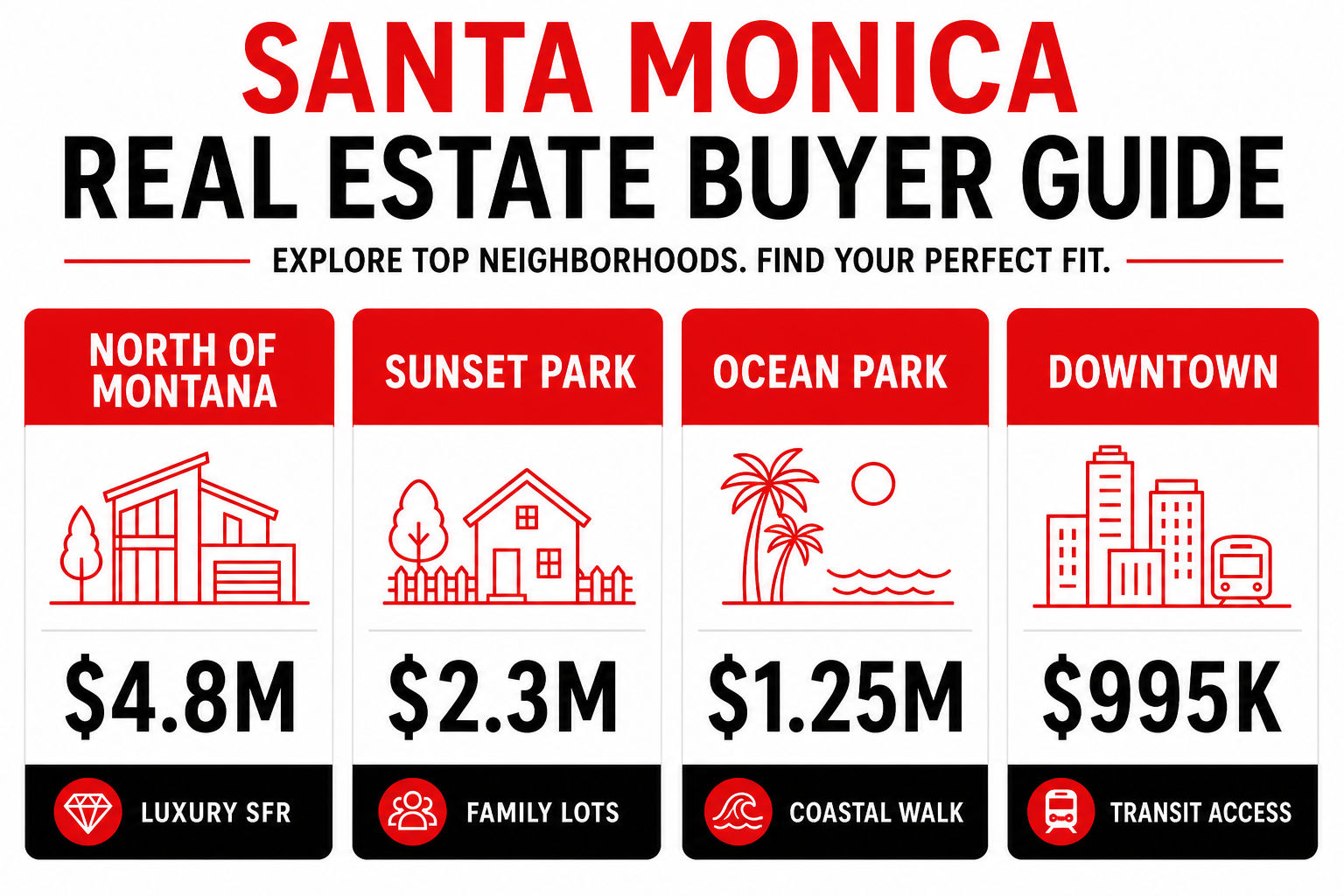
North of Montana (90402) is the city's prestige enclave. Median prices for single-family homes here ran around $4.8 million as of early 2026, with move-in-ready properties pushing considerably higher. Inventory is historically thin, homes rarely stay on market long, and sellers here typically hold for well over a decade before listing. For buyers targeting this area, the primary challenge is sourcing listings before they reach the open market.
Sunset Park offers larger lots, older housing stock from the 1920s through the 1950s, and a median around $2.1 to $2.5 million depending on the source and timing. Families favor it for its quieter streets, neighborhood parks, and schools. Investors have also been drawn here specifically for ADU potential; the lot sizes in this submarket often accommodate detached accessory dwelling units, and California's recent legislative framework has made those additions more feasible across many parcels. If lot size and long-term flexibility matter to you, this area is worth a close look.
Ocean Park (90405) sits in Santa Monica's southwest corner and draws a younger, creative-professional buyer base. Its walkability is genuinely exceptional, with Walk Scores consistently above 90, and Main Street's dining and retail corridor creates a neighborhood feel that coastal density rarely achieves. Median pricing here landed around $1.25 million in early 2026 for condos and low-to-mid twos for detached homes. South Santa Monica as a whole actually posted a 23.2% year-over-year median increase as of February 2026, which reflected a combination of genuine demand and a shift in the composition of sales toward larger properties.
Downtown Santa Monica gives buyers the best access to the Metro E Line, dense transit, and the most walkable environment in the city. Condo medians here sit closer to the $995K range, making it the most accessible entry point for buyers who want a Santa Monica address without a seven-figure single-family commitment.
What to evaluate beyond price
Neighborhood choice is only part of the decision. Inside any of these submarkets, buyers should weigh several practical factors before settling on a target.
Layout and size relative to price per square foot. The spread between North of Montana and Ocean Park in price-per-square-foot terms is significant. Buyers who anchor their comparison to raw list price rather than per-square-foot value often misjudge what they are actually getting for the money.
ADU and zoning potential. California's housing legislation, including Senate Bills 684 and 1123, has expanded what landowners can do on many residential parcels. If future rental income or multigenerational living is part of your plan, checking zoning designations and ADU feasibility before offer day matters more than it once did.
HOA obligations on condos. Downtown and ocean-adjacent condos frequently carry monthly HOA dues and, in older buildings, the possibility of upcoming special assessments. Reviewing reserve studies and HOA financials during your inspection contingency period is not optional; it is one of the most important steps in a condo purchase.
Closing costs at this price level. California buyer closing costs typically range from 2% to 5% of purchase price. On a $1.8 million Santa Monica purchase, that translates to roughly $36,000 to $90,000 in costs beyond your down payment. Property tax in Santa Monica generally runs around 1.1% of assessed value, and coastal proximity can affect insurance premiums. Planning for these figures early prevents surprises during escrow. For a detailed breakdown of what buyer and seller costs look like in California, the 2026 closing costs breakdown from the Super Woman Super Realtors blog is a useful reference.
Schools and district verification. The Santa Monica-Malibu Unified School District assigns schools by address, and the school a specific property is zoned for can influence both your family's decision and the long-term resale demand for that home. Always confirm assignments directly with SMMUSD before finalizing your target neighborhoods.
Natural hazard disclosures. Coastal proximity brings flood risk considerations, and roughly 25% of Santa Monica properties carry some level of wildfire risk. California requires sellers to provide a Natural Hazard Disclosure report, and buyers should review it carefully alongside any lender-required insurance requirements.
| Neighborhood | Approx. Median (Early 2026) | Best Fit | ADU Potential |
|---|---|---|---|
| North of Montana | ~$4.8M (SFR) | Luxury, established lots, privacy | Limited; tight inventory |
| Sunset Park | ~$2.1M-$2.5M | Families, lot size, long-term value | Strong; larger lot sizes |
| Ocean Park | ~$1.25M (condos) / ~$2M+ (SFR) | Walkability, coastal lifestyle | Moderate |
| Downtown | ~$995K (condos) | Transit access, entry price | Lower (condo-heavy) |
Where local representation helps most
Buyers sometimes assume that in a digital search environment, having a local agent is optional. In Santa Monica, that assumption is expensive.
Reading the offer landscape correctly
With roughly 98% sale-to-list ratios and a meaningful share of listings still receiving multiple offers, the difference between a winning and losing offer often has nothing to do with price alone. Offer structure matters: contingency timelines, flexibility on close date, inspection approach, and lender credibility all factor into how a seller evaluates competing bids. An agent who regularly works this market knows what sellers in each submarket tend to prioritize, and that information does not show up on any portal.
The Southern California real estate 2026 market report from Super Woman Super Realtors covers broader regional trends that provide useful context for buyers weighing multiple Westside markets. And if you are still deciding whether Santa Monica or another West L.A. community better fits your goals, the West Los Angeles neighborhoods guide walks through the lifestyle and cost-of-living differences in detail.
Managing inspections and contingencies
A standard California purchase contract gives buyers inspection contingency periods of roughly 7 to 17 days for physical inspections, and loan contingency windows of 17 to 21 days. In a market where sellers are more willing to consider contingencies than they were during the bidding-war years, keeping those protections intact is reasonable, but timing matters. Arriving at offer day with a pre-approval from a Westside-familiar lender, a clear sense of your inspection priorities, and an agent who can communicate directly with the listing side shortens the friction at every step.
For condo buyers specifically, HOA document review adds a layer of complexity. CC&Rs, reserve studies, special assessments, rental caps, and insurance certificates all arrive as a package during escrow, and buyers have a limited statutory window to review and act on them. Skipping this step or rushing through it is one of the most common mistakes buyers make in attached-property transactions. Per California DRE guidelines on common interest developments, understanding your rights during this review period is foundational to a protected purchase.
Comparing Santa Monica to other West L.A. and Southern California options
For some buyers, Santa Monica is the clear target. For others, the comparison involves weighing it against Beverly Hills, Culver City, Venice, or even stretching east toward more affordable Southern California communities. Buyers who have done the research sometimes find that what they want from Santa Monica, specifically walkability, coastal access, and school quality, is also achievable at a lower price point in a neighboring submarket.
Working with a Southern California real estate agent who covers both the Westside and Inland Empire markets means you can have that conversation honestly, without the assumption that the most expensive option is always the right one. If you are finding homes in Southern California across multiple price points and communities, having a single trusted point of contact for that comparison makes the process significantly less fragmented.
For buyers considering Santa Monica as a longer-term investment alongside other Southern California markets, reviewing what the West Los Angeles overview page covers will help frame how this market fits into a broader regional picture. And if you want context on how moving to this part of Los Angeles compares to other parts of Southern California, the Moving to West Los Angeles guide is worth reading before you commit to a search area.

Frequently Asked Questions
What is the average home price in Santa Monica in 2026?
Median prices range from roughly $995K for downtown condos to $4.8M-plus for North of Montana single-family homes. Citywide medians across all types sit near $1.78M.
Is Santa Monica a buyer's or seller's market right now?
Early 2026 conditions are balanced to mildly seller-leaning, with about 4.2 months of supply and homes selling near 98% of asking price.
What are typical closing costs for buyers in Santa Monica?
Expect 2% to 5% of the purchase price. On a $1.8M home, that is roughly $36,000 to $90,000 beyond your down payment.
Which Santa Monica neighborhood offers the best value for families?
Sunset Park is frequently cited for its lot sizes, family-friendly streets, and more accessible pricing compared to North of Montana.
Do I need a local agent to buy in Santa Monica?
Local representation helps significantly with offer structure, submarket knowledge, contingency timing, and access to listings before broad market exposure.
Buying in Santa Monica rewards preparation. The neighborhood you choose, the offer terms you bring, and the guidance you rely on all directly affect the outcome. Whether you are comparing submarkets, working through closing cost planning, or deciding between Santa Monica and another part of West Los Angeles, having a clear-eyed local advocate in your corner is the one variable that stays consistent across every transaction. To get started with someone who knows both this market and the full Southern California landscape, connect with Vicki Galvan and take the first real step toward your next home.